9 Jun 2015

introducing the kaweco skyline classic sport mint EF

So, a few weeks' ago, I talked about the Pilot Kakuno and Lamy Safari and now, I want to talk about another fountain pen: the Kaweco Skyline Classic Sport. I'll confess, I was never the biggest fountain pen fan but the Lamy Safari changed that in early-2013. The Pilot Kakuno only reinforced this new-found love of fountain pens.


The Kaweco Skyline Classic Sport was a pen that had been on my want list for a long time and when revision time came around, I decided to treat myself to it (and because I'd just finished a super stressful surgery placement). I'm glad I did - Tiger Pens' service has been nothing short of excellent as the first pen I received had a nib that didn't write very well and they offered me a prompt exchange.


I chose the extra fine nib because I've grown an affinity to a fine line over the last two years. My Lamy Safari also has an extra fine nib but it is still a bit too thick for me (although it is ideal for those high speed revision scrawlings) but my Pilot Kakuno fine is perfect. Having done some research online, I've since found out that Japanese fountain pens do tend to have finer nibs which explains why a fine Kakuno writes finer than an extra fine Lamy.


As a fairly new user of fountain pens, I only use cartridges supplied by the respective companies because I can't be doing with converters and bottled ink at the moment - I just don't have the funds or time (read: patience) at the moment.

So, onto the business end of this blog post: the actual review. The Kaweco is a lovely petite pen that is light and well designed. I opted to purchase the pen clip too and chose the silver version. Because of it's size, I find it easier to use when it has its cap on. This not only adds some much needed length, it also helps balances out the pen's (minuscule) weight.
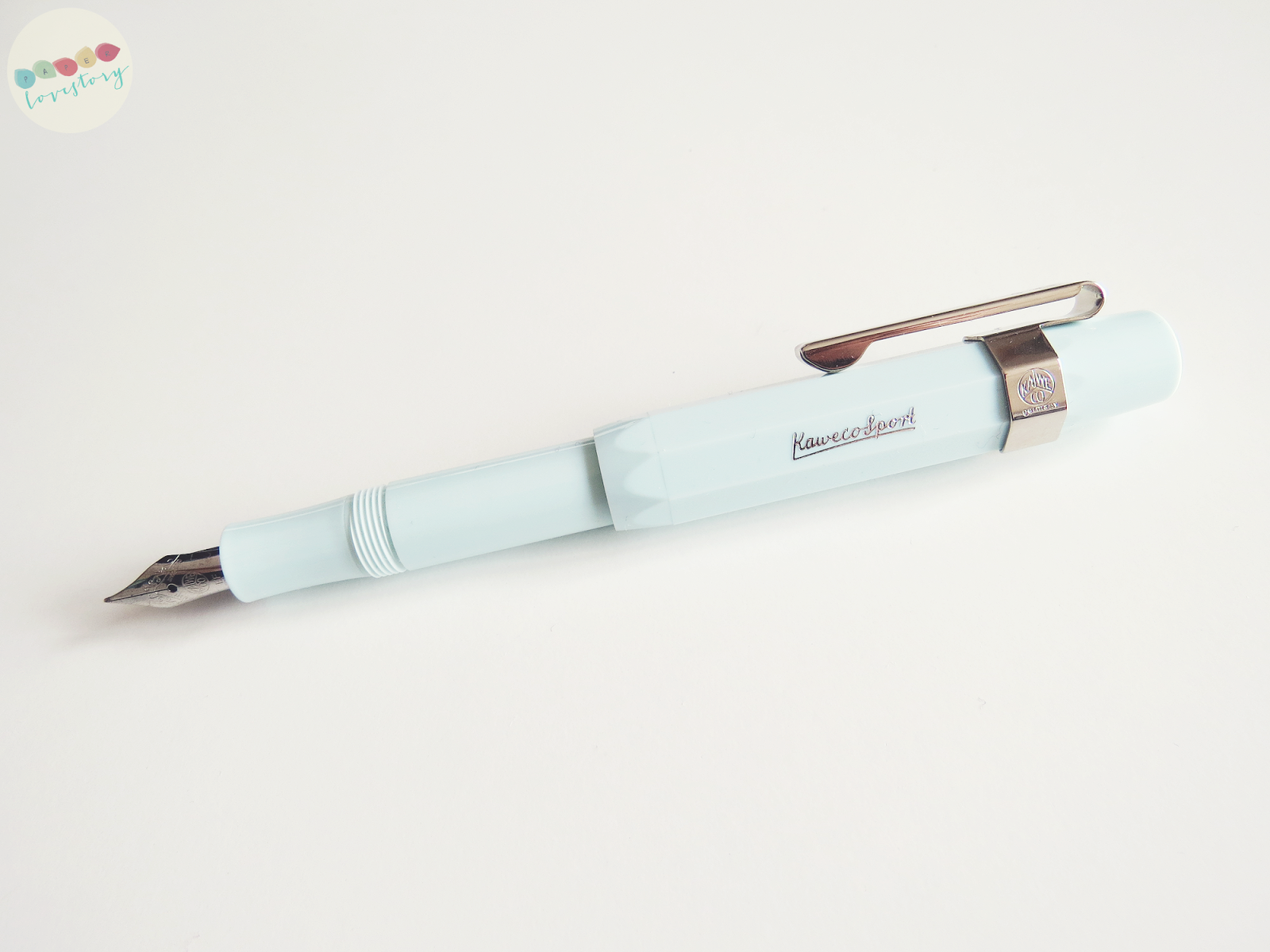

My nib writes perfectly and the ink doesn't skip. It is smooth and glides wonderfully over even the roughest of paper without any hint of scratchiness. In terms of price, I paid £17.99 for this pen and I think that's perfectly reasonable for an entry-level fountain pen although it isn't as cheap as the Pilot Kakuno (which I think writes a fair bit smoother). Also, I find that the cartridges don't last as long as the Lamy or Pilot ones.


Overall, I would give this pen a 7.5/10 based on its affordability, design and nib. I'm still not a total fountain pen convert but these entry level ones suit me so well that I can't ever imagine myself paying more than £20 for a fountain pen in the future.

And just as a side note, I paid for this pen myself.

7 Jun 2015

my week #164

This week was filled with a teaching session, a meeting and a clinic followed by a day of data analysis and then a day of admin. Three colleagues and I have formed a team for the upcoming student union elections because we've decided to run for next year's 'year representatives'. We're going up against another strong team but what we've got on our side is diversity. Obviously, my obsession with meticulous planning means we have a plan of attack (not against them mind you - we won't stoop that low!) all set out for campaign week which starts tomorrow. I may even blog about this process in the future because I actually found it all quite enjoyable and here's hoping it all pays off!

Aside from that, I spent yesterday cleaning the house and today baking. I used to think I was quite extroverted but maybe I'm more introverted than I'd like to admit. Sometimes, there's nothing better than spending the day in solitude with some flour, sugar and butter :)


How has your week been?

4 Jun 2015

pharmacology learning: tackling one drug at a time

Pharmacology is a huge and important topic for medical students. There are just so many subtitles within it: indications, pharmacokinetics, pharmacodynamics, contraindications, side effects... and these are the only sections I can think of off the top of my head and it doesn't even include dosage and mode of administration which are just as important!

I'll admit that how I've gone about learning pharmacology has been somewhat unorthodox. I enjoy learning about medicines and chemical agents that have a physiological effect on the body (see what I did there? I bypassed the use of the word 'drugs' ;) ) so, in a way, it has come a bit easier and possibly a bit more naturally to me due to my biochemistry background.

Nonetheless, here are the stages I took to learn pharmacology.

1) Write out the brief details for each commonly prescribed drug.

Using a combination of various textbooks and lecture notes, I'll write out the drug class, indications, side effects, contraindications, interactions and other special points. I usually leave mechanism of action out unless I'm really struggling to remember it (as I'm okay with the mechanism of most medicines that we needed to know for exams this year).


2) Flashcards are amazing for pharm learning!

They can enable you to make piles of them: 'drugs I'm confident with', 'drugs I'm a bit fuzzy on' and 'drugs I definitely need to dedicate more time to' are just three piles I use myself. Plus, they are useful for learning in pairs where you can ask a friend to quiz you and vice versa! I get my sister to quiz me usually because she's not a medic so she can't judge me if I get an obvious thing wrong!

Pictured below are the Rang and Dale Pharmacology Flashcards and some I made myself.


3) Draw things out, over and over!

I learn by doing and also by using pictures/visual aids so for me, this is essential. I use colour, boxes, arrows and try to strip everything down as much as possible. 


4) Integrate pharm learning with clinical medicine!

One thing I did was draw out a table of the conditions I needed to know for exams this year and then try and remember the 1st line, 2nd line and 3rd line drugs for them all from memory. This helped me identify gaps and areas of confusion so that I could give them more attention during revision.


5) Test yourself when on the wards with drug charts!

Get hold of a patient's chart and test yourself. What class of drug is it? Why was it prescribed? What else is the patient on - are there any drug interactions? Look at the dose and then compare this with the British National Formulary (there's a phone app for it now - super handy!). Is the drug chart filled in correctly? When was each medication given - is there a particular reason for the timings? Etc, etc.

Furthermore, relating a drug to a patient you've seen makes it that much easier to remember what the drug is, why it was prescribed and the effect it had on them.

Ultimately, pharmacology is a balance between memorisation and understanding the mechanism of action of the drugs. I personally enjoy pharmacology learning and I can't, for the life of me, tell you why - I think it's just one of those weird things about me. My memory has always been pretty good so maybe that's why?

Do you have any tips? I'm always looking for ways to improve my pharm knowledge!

2 Jun 2015

my top five tips for reading with a busy life

Even though I'm not at home between 7:20am and 7pm (sometimes even 8pm or later) most days, I still make time to read, on average, one book every ten to fourteen days. I really enjoy reading and my 'to-be-read' list/shelf just gets longer and longer and at a ridiculous pace too. Anyway, I thought I'd share how I manage to read so much when I also, usually, have copious amounts of study to do.

1) Break your 'to-be-read' list down to a manageable level.

I do this by picking out three or four books that I want to read next and sometimes, books are replaced on a whim depending on what mood I'm in. An example is the picture below where I went on a book-buying spree on Amazon (well, to be fair, I was taking advantage of a 3 for £10 deal - it would've been rude not to) and so these books were bumped to the top of my pile. Later on, I moved Persuasion lower down the list as my thinking was that I'd want to read something more modern after The Book Thief - but then I found myself putting down The Book Thief after a few chapters because it was just too heavy for my brain at the time (it was revision time!).

By breaking down your list into 'immediate reads', 'want to read soon' and 'will read when I feel like it', these mini-lists can make reading less daunting. And also more exciting too if you put a book you've been super eager to read in your 'immediate reads' pile!


2) Budget some time for reading.

Every morning, I read for half an hour while I'm eating breakfast (this is a kind of 'me time'). It doesn't take me half an hour to eat my breakfast but this allows me a chunk of the day where I will definitely have a chance to read. I also try and read at least one chapter (or two/three if the book is shorter) before bed as a way to unwind. 

3) Invest in a Kindle/phone which has an eReader app.

My parents gifted me a Kindle when I graduated from my first degree, way back in June 2012 and it has seen so much use. It is super light, durable and I can't believe I've almost had it for three years. Ever since getting it, the number of books I've read each year has increased exponentially. Electronic versions of books aren't the same, I'll concede that, but the portability and ease of use is unrivalled. 

The next best thing is an eReader app for your iPad/tablet/phone!

4) Read a variety of books from different genres.

I'm a chick-lit/young adult book reader at heart but that doesn't mean I don't move out of my comfort zone from time to time. Non-fiction can be educating (my favourite non-fiction book is Mutants - a book on genetic mutations and other interesting things) and doesn't have to be boring! 

5) Don't feel guilty for taking an hour or two out of your daily schedule to read.

This one is easier said than done - especially during times of high stress, such as exam time or deadline time! However, reading is a great way to relax and lose yourself from this world for a small portion of your time. And put it this way - nothing is more important than your health, and this includes your mental health. No one can work for 24 hours a day, seven days a week without going a bit crazy so whether you read/exercise/watch TV for that hour or two every day, it's definitely not wasted time!

To finish off, here's a picture of my copy of Fangirl. I couldn't help myself and bought the special edition cover because I just loved the book so much (I'd only had the Kindle version previously!).


Do you have any tips for reading? :)